

 Financial security
 10 steps
Quick answer: how to tell if a boleto is fake
- Get the boleto (Brazilian payment slip) only from the company's official app or website. Be wary of slips that arrive by WhatsApp, text or unexpected email.
- On the payment screen, check the payee's name and CPF or CNPJ. It must be the company billing you.
- Also check the amount and due date. Any difference: don't pay.
- Turn on DDA in your bank's app: boletos registered to your CPF show up there.
- Already paid? Call your bank right away, keep the evidence and file a police report.
What's your case?
Fake boleto: 10 steps to spot one and what to do if you paid
1Get the boleto only from official channels
- Download the boleto from the app or customer area of the company's website, typing the address yourself.
- Be wary of slips that arrive unrequested by WhatsApp, text or email, especially with a "discount if you pay today".
- Got a bill from someone you don't know? Don't pay before confirming with the company.
2Check the payee on the payment screen
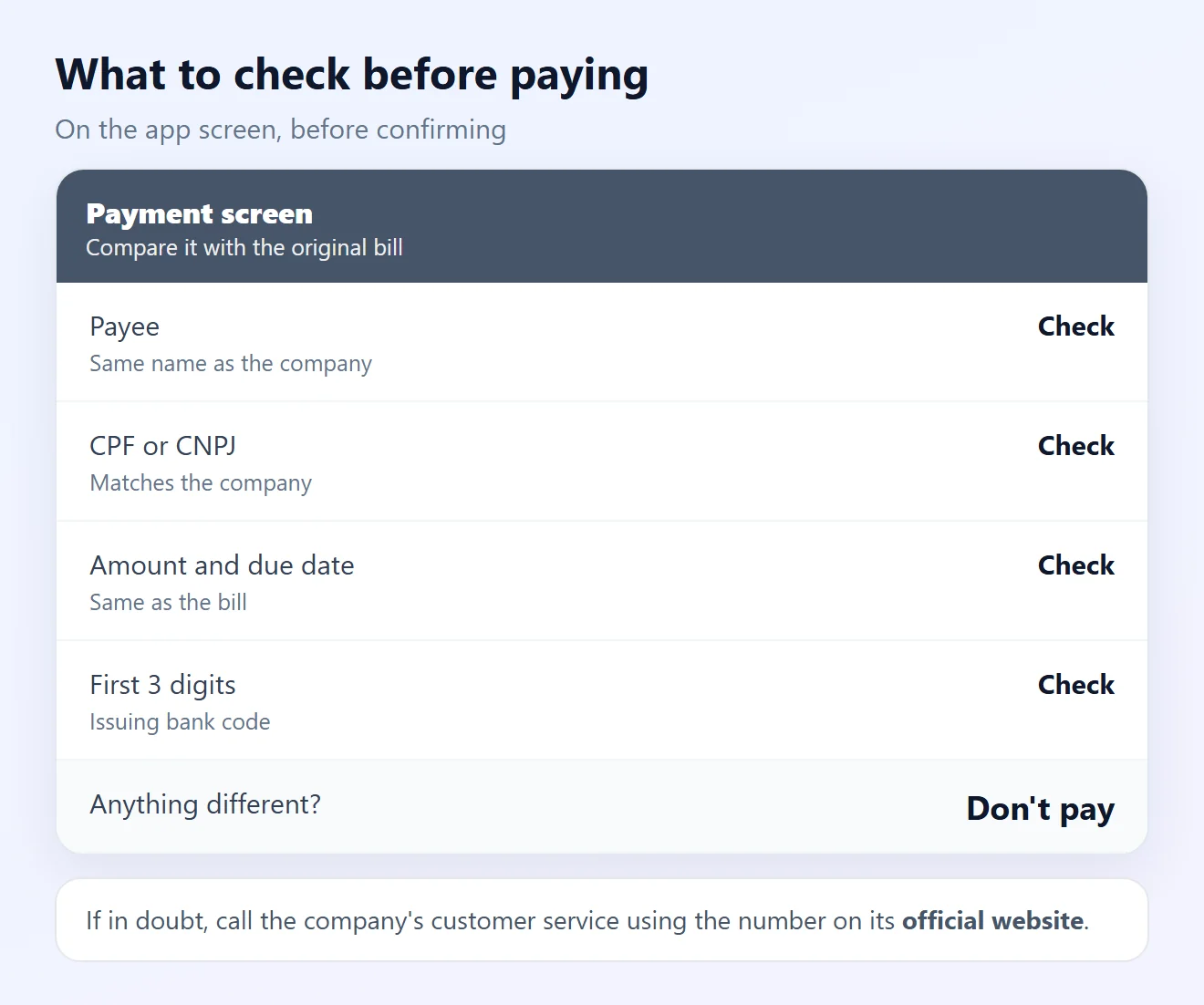
- Since Brazilian banks' new billing platform (rolled out from 2017 to 2018), boletos are registered. When you pay, the app, internet banking or ATM shows the payee, who will receive the money.
- Check the name and CPF or CNPJ. If an individual or a different company shows up, don't complete the payment.
- If in doubt, call the company's customer service using the number on its official website, not the one on the slip.
3Look up the payee's CNPJ
- Copy the CNPJ (company tax ID) shown on screen and look up the registration certificate on the Federal Revenue website.
- The legal name must match the company you know. Some show their legal name, different from the brand: check on the company's website.
4Check the amount and due date
- Compare with the original bill: contract, invoice or customer area.
- A different amount, an odd due date or a discount you didn't negotiate are warning signs.
5Understand what the code line shows
- On a bank boleto, the first 3 digits are the issuing bank's code. Look it up and check that it matches the bank shown on the slip.
- On the same type of boleto, the last 10 digits show the amount in cents. Example: 0000015000 = R$ 150.00.
- Utility bills, such as water, power and phone, start with 8 and use a different format.
6Turn on DDA in your bank's app
- DDA (Débito Direto Autorizado) shows the boletos issued under your CPF in your bank's app.
- If the boleto you got doesn't show up in DDA, or shows a different payee, be suspicious and confirm with the company.
- DDA isn't automatic debit: nothing is paid without your approval.
7Be careful with copies found online
- Scammers create websites and ads that imitate power and internet companies, schools and lenders.
- Get a copy of the boleto only from the official app or website. Check the address before entering your CPF or contract details.
8Watch out for tampered boletos
- Computer viruses and hacked email accounts can swap the barcode of a real boleto while keeping its look.
- If the boleto has a Pix QR code, check the recipient's name before confirming.
- Pay through your bank's app, reading the code straight from the company's app. Keep your antivirus and system up to date.
9Paid a fake boleto? Act fast
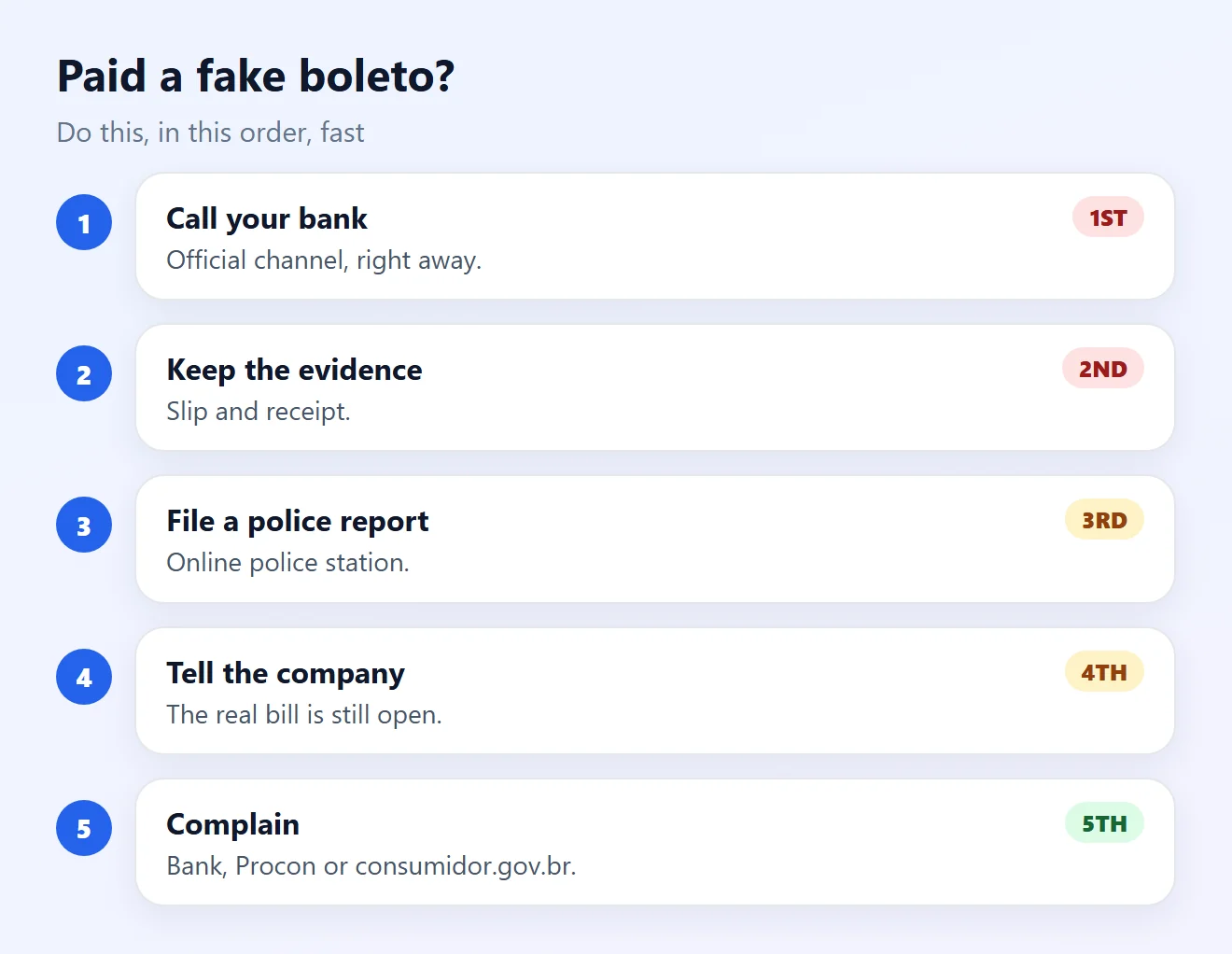
- Call your bank right away through the app or the number on the back of your card. Ask to dispute the payment and get a ticket number.
- Keep the fake boleto, the receipt and the messages or emails that brought it.
- File a police report, which you can do at your state's online police station.
- Tell the real company: the original bill is still open. Ask for more time while the case is reviewed.
10Know your rights and avoid new scams
- Under Brazil's Superior Court of Justice (STJ) Precedent 479, banks are liable for damage from fraud linked to banking operations. The outcome depends on each case, for example, whether the payee details were visible and different.
- No solution from the bank or company? Complain on consumidor.gov.br or with Procon. As a last resort, at the Small Claims Court.
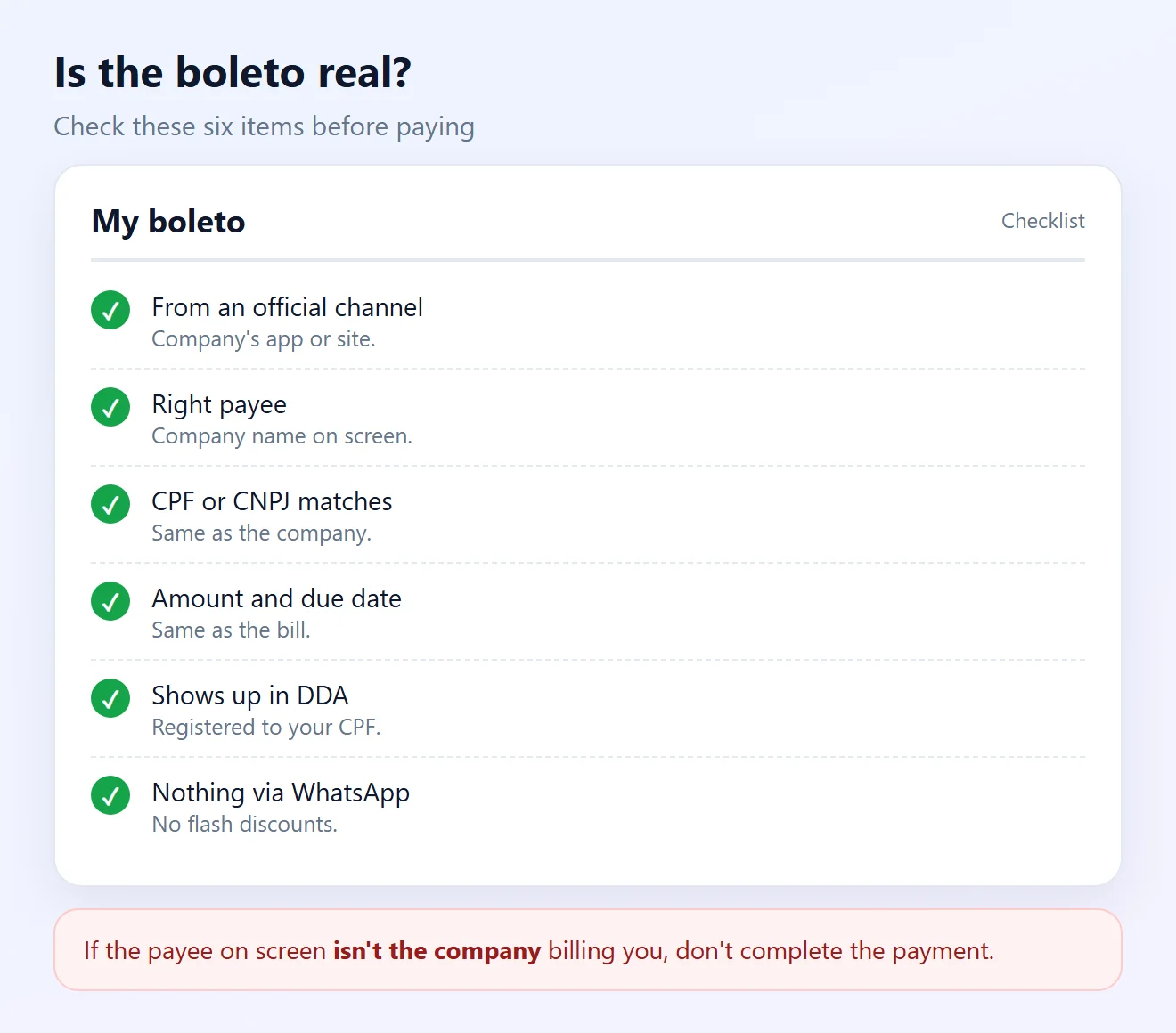
- Before every payment, repeat the check: official channel, payee, CNPJ, amount and DDA.
See also how to create a secure bank password and how to dispute a purchase you don't recognize.
Signs of a fake boleto
| Sign | What it may be | What to do |
|---|---|---|
| Payee is an individual | Scammer's account | Don't pay and call the company (step 2) |
| Another company's CNPJ | Forged boleto | Look it up at the Federal Revenue (step 3) |
| "Today only" discount on WhatsApp | Fake negotiation | Get it from the official channel (step 1) |
| Amount in the code differs from the print | Tampered boleto | Check the code line (steps 5 and 8) |
| Boleto not in DDA | Not registered to your CPF | Confirm with the company (step 6) |
| Copy from an unknown site | Fake website | Use only the official app or site (step 7) |
Frequently asked questions
How can I tell if a boleto is real?
Get it from the official channel and, on the payment screen, check that the payee's name and CPF or CNPJ belong to the company billing you, along with the amount and due date.
Where does the payee show up?
On the payment confirmation screen, in the app, internet banking or ATM, before you confirm.
What is DDA?
It's Débito Direto Autorizado, which shows the boletos issued under your CPF in your bank's app. It isn't automatic debit: you decide what to pay.
What do the first digits of a boleto mean?
On a bank boleto, the first 3 digits are the issuing bank's code. The last 10 show the amount in cents.
I paid a fake boleto. What should I do first?
Call your bank right away through official channels, ask to dispute the payment and write down the ticket number. Then keep the evidence and file a police report.
Can I get my money back?
There's no guarantee. The faster you tell the bank, the better your chances. Banks are liable for fraud linked to banking operations, but the outcome depends on each case.
Do I have to pay the real bill again?
The debt with the company is still open. Tell the company about the scam, show the evidence and ask for more time while the case is reviewed.
Is a boleto with a Pix QR code safe?
Only if the Pix recipient's name is the company's. Check before confirming.
Can I trust a copy found on Google?
No. Fake websites and ads imitate companies. Get a copy only from the official app or website.
Where can I complain if the bank doesn't help?
On consumidor.gov.br, with your city's Procon or, as a last resort, at the Small Claims Court.
Related content
More practical solutions in Financial security.

Unrecognized Card Transaction: What to Do
Learn what to do after finding an unrecognized credit or debit card transaction, how to protect your account, and how to start a dispute with your financial institution.
 10 minutes
 Pix
Pix Transfer Not Received: How to Check Delays and Resolve the Problem
Pix transfer not received? Learn how to check the transaction status, how long to wait, and what steps to take when the money does not appear.
10 to 15 minutes
Pix Scam: How to Act Quickly and Protect Your Money
Learn what to do after a Pix scam, how to report the incident, contact your bank promptly, and protect your accounts.
Sources
- Febraban: fake boleto scam, how to avoid it (in Portuguese)
- Febraban: new billing platform, registered boletos (in Portuguese)
- Febraban: DDA, Débito Direto Autorizado (in Portuguese)
- Federal Revenue: CNPJ registration certificate (in Portuguese)
- STJ: Precedent 479, bank liability for fraud (in Portuguese)
- consumidor.gov.br: complaints against companies (in Portuguese)
The images on this page are illustrations created by Fixfy.